
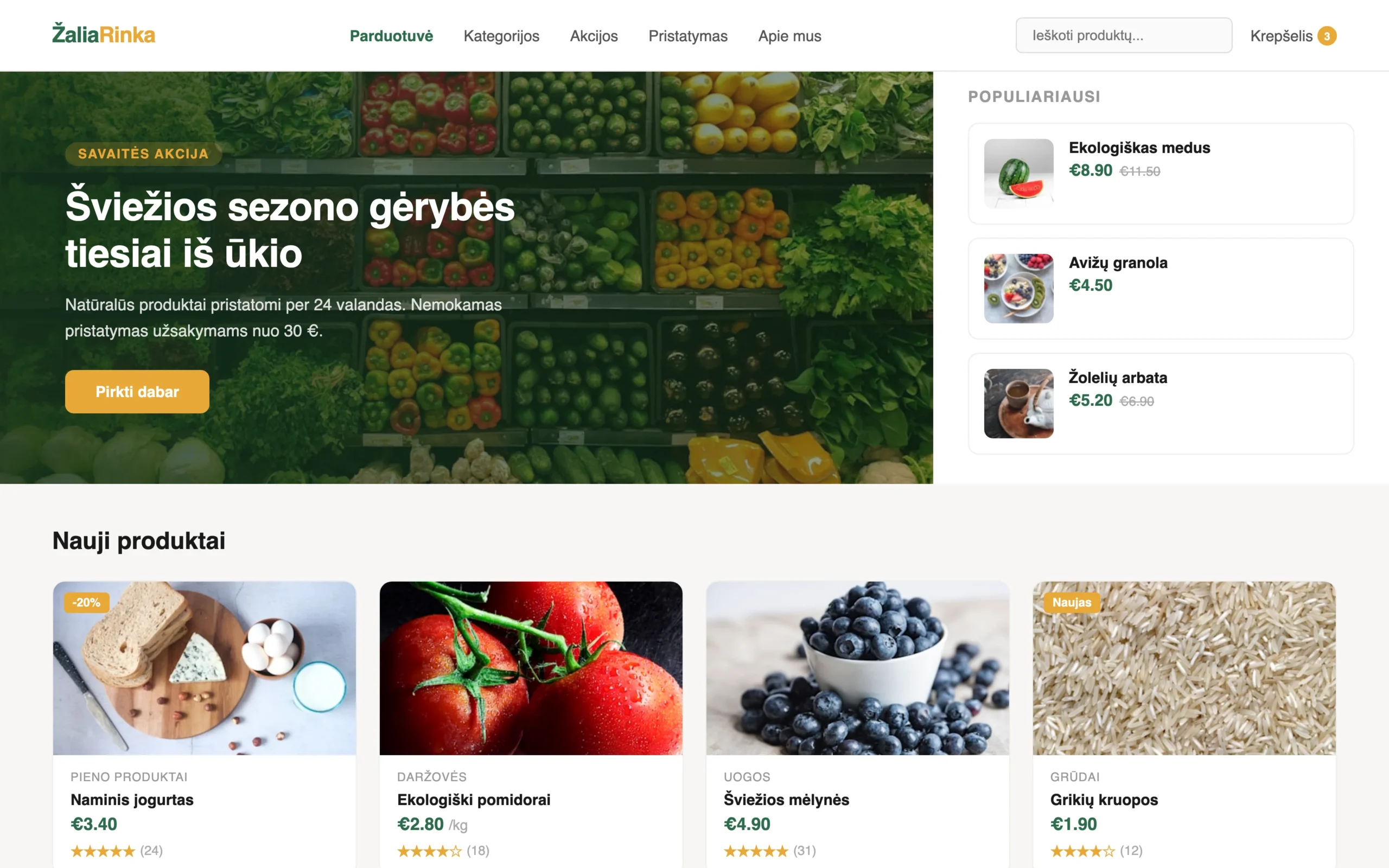
People who want to sell online usually ask first: “Where do we start?” The answer is shorter than it seems: hosting, a platform, payments and legal documents. Below is how we launch an online store in Lithuania: which tools we use, what you must have before launch and roughly what it costs.

Hosting: where your store will run
Hosting determines the speed of the store and whether it can handle a rush of visitors, for example during sales. The longer a page takes to load, the more visitors close it without waiting.
We often work with Hostinger - its price-quality ratio is good for a small store. WordPress hosting plans (names and terms change, so check before buying) usually include:
- A free SSL certificate
- A free domain for the first year
- Servers in Europe - a shorter response time for visitors in Lithuania
- An environment adapted for WordPress
Partner link: signing up through this link may give an extra discount, and we receive a commission. Note that Hostinger advertises an introductory promotional price, and when you renew the plan you will pay considerably more. If needed, we will help set everything up.
Choosing a platform: an online store in Lithuania with WordPress
For online stores we most often recommend WordPress and WooCommerce. Why?
- Full control - the data and the website belong to you
- Flexibility - it fits most business models
- An ecosystem of integrations - MakeCommerce, Paysera, Omnisend and hundreds more
- Easy to extend - from a catalogue to custom systems as the business grows
- No monthly platform fee (you pay for hosting and choose paid plugins as needed)
Payments: MakeCommerce - a solution for the Baltic market
In Lithuania online stores most often choose local payment providers, for example MakeCommerce or Paysera. We often use MakeCommerce - a solution built for the Baltic countries, which supports:
- Payments through online banking (Swedbank, SEB, Luminor and others)
- Payment cards (Visa, Mastercard)
- Apple Pay and Google Pay
- Payment in instalments
Compared with Stripe or PayPal, the advantage of local providers is that all payment methods popular in Lithuania, including bank payments, are in one place, and fees in the Baltic market are often more favourable. For a WooCommerce store the plugin is usually connected within a few hours.
Sign up for MakeCommerce (partner link). At the last step of registration, in the comment field, mention the BoxInCoded offer - then special fees apply: 0.9% for payments through online banking and 1.9% for card payments. The final rates are confirmed by MakeCommerce.
What else is worth knowing before launch
Before launching an online store make sure you have:
- A privacy policy (GDPR) and a cookie consent banner (the Law on Electronic Communications)
- Seller details, purchase terms, delivery and returns conditions (including the 14-day right to withdraw from the contract) and information about dispute resolution with the State Consumer Rights Protection Authority (VVTAT)
- An SSL certificate (required for payments)
- A design adapted for phones - a large share of buyers browse and buy on a phone
- Automatic emails to buyers: an order confirmation and, if you can, an abandoned cart reminder - more in the article on email automation
How much does an online store in Lithuania cost?
The budget consists of one-off and ongoing costs. Building an online store with a catalogue, payments and delivery zones indicatively costs from €1,400 (an approximate timeline of 4-7 weeks), more on the online store development page. Ongoing costs: hosting about €60-150 per year, a domain about €10-20 per year, payment fees about 1-2% of turnover (depending on the payment method and provider) and, if you want to hand the technical worries to someone else, maintenance, the price of which we estimate for a store by its scope.
The most common mistakes when launching
- Too many features for the first version - launch with the essential range and extend according to real buyer needs.
- Forgotten delivery price calculation - wrong delivery prices reduce your margin or put buyers off at the last step.
- An untested purchase path - before launch, place at least one real order yourself: from the cart to payment and the confirmation email.
- Launching without analytics - without GA4 events you will not know at which step you are losing buyers.
Planning your own online store? Get in touch - we reply within 1 business day, and after a short conversation we will give you a plan and an indicative price.
Selling to customers in several EU countries, not only in Lithuania? See our practical checklist for launching an online store in the EU.
More articles
 Business How to launch an online store in the EU: a practical checklist
A practical checklist for launching an online store in the EU: platform, hosting, payments by country, delivery, VAT and OSS, and the…
 Business An online store from scratch: the path to your first order
Five steps between "we need an online store" and the first paid order: range, platform, payments, content and launch.
 Marketing Website promotion: where to start with SEO?
Launched your website but the phone is silent? Four SEO jobs, done in the right order, before you pay a cent for…